
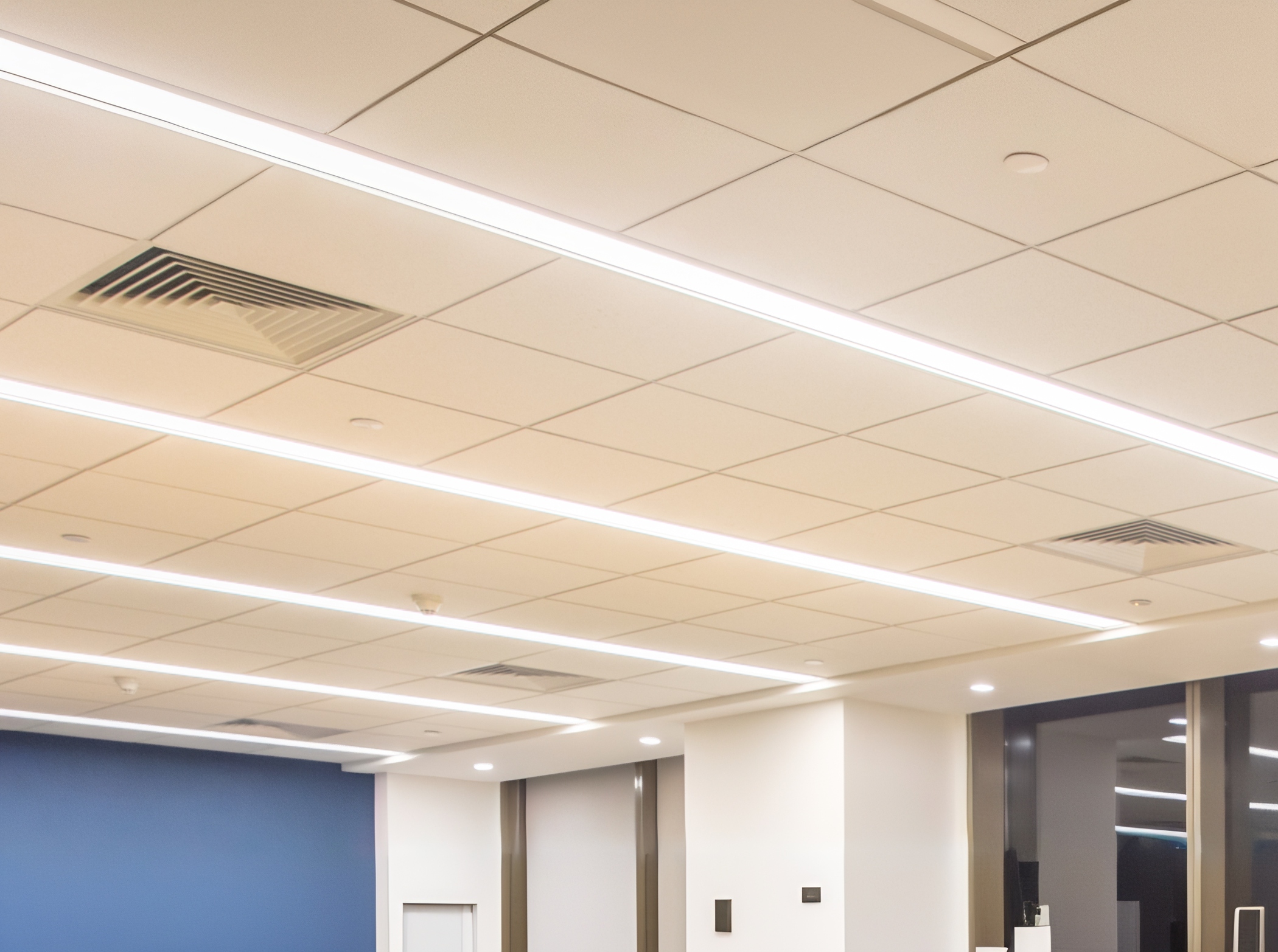
High-efficiency LED lighting is becoming widely adopted in commercial and industrial facilities across the country, and for good reason. They not only reduce energy costs, but they also last longer than conventional lights and provide improved light quality.
LEDs also start instantly and are almost all inherently dimmable, making them perfect for controls, an often untapped source of additional energy savings in lighting upgrades. Advanced networked lighting controls (NLCs) are the latest evolution in lighting technology. Combined with high-efficiency LEDs, they can reduce lighting energy use by an additional 50%, according to one study. Another potential benefit of NLCs is integrating them with HVAC controls for even deeper savings.
How networked lighting controls work
NLCs are systems in which individual lighting elements are interconnected through a digital network, enabling centralized management and automation for enhanced energy efficiency. Components of the system include:
- Light fixtures.
- Occupancy and daylight sensors.
- Controls, such as switches and dimmers.
- A wired or wireless communication network connecting all components.
- Software interface with capabilities, such as real-time monitoring, energy reporting and maintenance alerts.
Networked sensors and control devices can either be embedded in the fixtures or installed as separate components. Embedded devices simplify installation by reducing the need for additional wiring or separate components. Standalone components offer more flexibility in sensor placement for optimal performance and are easier to repair or replace. They are often more effective in larger facilities, where customization and scalability are critical.
NLC components work together to provide energy savings, convenience and enhanced control over lighting in various environments. NLC system capabilities typically include:
- Occupancy sensing that adjusts lighting based on the number of people in a space.
- Daylight harvesting that reduces or eliminates light based on the amount of daylight present.
- Light scheduling based on time of day, week or the season.
- Personal control, where users can adjust lighting based on preferences or needs.
The benefits of HVAC integration
While NLCs can provide many benefits, they can be expensive to install, and lighting makes up only about 10% of commercial building energy use, according to the U.S. Department of Energy. While NLCs can significantly reduce lighting energy use, the cost savings may not be worth the investment in some cases.
HVAC systems, however, make up 56% of energy use in commercial buildings. The combined savings from integrating lighting and HVAC controls in one upgrade can be substantial. A study by the DesignLights Consortium (DLC) found that when NLCs are paired with HVAC controls, total energy savings of 20% can be achieved in some buildings. That kind of savings can provide a good return on investment.
Making the connection
Lighting is everywhere in buildings, and NLCs provide powered, connected occupancy sensors throughout the space. Data from these sensors can identify occupancy patterns and space utilization trends that can be used to optimize HVAC energy savings and building comfort.
Such integration can save energy in multiple ways. For example, NLCs with occupancy sensors can share real-time occupancy data with the HVAC system. When light sensors indicate that a room is unoccupied, HVAC controls can adjust settings to conserve energy. NLC data can also be used to create HVAC zonal schedules based on building usage patterns.
NLC and HVAC integration can be most effective in larger buildings, especially those with a building automation system already in place. The integration process can be complex, however. That's why the DLC created the NLC-HVAC Integration Toolkit. It includes a helpful handbook, decision tree, case studies and more.
By using data from advanced lighting controls to better manage your HVAC system, you can significantly reduce operating costs while ensuring the comfort of your facility.